Northern prophets Hosea 8th C and Amos 8th C coming fall of northern kingdom variously called Israel, Ephraim, Samaria
Early prophets 8th C Isaiah, Amos, Hosea and Micah
Pre-exilic prophets who prophesied before and during the fall of Jerusalem Jeremiah, Baruch, Lamentations, Ezekiel, Nahum, Habbakuk and Zephaniah
Exilic prophets Daniel, Jeremiah though he didn't go to Babylon, Deutero-Isaiah
Post exilic prophets Haggai, Zechariah, Malachi, Obadiah, Trito-Isaiah Re-read Ezra and Nehemiah as additional context for these prophets and re-read 2 Kings for a refresher on Elijah
Prophets who prophesied about the fall of Assyria (Nineveh) in 612 B.C. Jonah
Obadiah might be considered post-exilic and Joel lacks sufficient information to be placed
Assyrian power 800s B.C.
Fall of Samaria at hands of the Assyrians 722 B.C.
Assyria falls, Nineveh 612 B.C.
Babylonions 700s B.C.
Rise of Babylonians 600s B.C.
Fall of Jerusalem 597 B.C.
Final Sacking of Jerusalem 587 B.C.
Wednesday, August 3, 2016

Tuesday, November 11, 2014
A New Bible Museum To Open in 2017
Thursday, January 9, 2014
Postlogue - Revisiting 1, 2 Maccabees
Lectionary readings from back in November of 2013, not so very long ago, have occasioned another look at Maccabees, books interesting for their historical context, but books which I found to be heavy, turgid texts filled with events that I had difficulty sorting out.
 Basically, if one remembers that the post-Alexandrian world of the Maccabees was divided up between Alexander the Great's generals--for our purposes, Ptolemy in Egypt and Seleucus in Babylonia--and that they and their descendants were constantly in a battle for securing the territory around Judea for themselves, it becomes easier to follow the actions of the books of Maccabees. Inter-laced with this over-arching conflict between Ptolemies and Seleucids is the intrigues of the Jewish priesthood which has its own power grab going on. There are those Jews who valorously remain true to their God, while others cash out and go over to the Greek side in order to enjoy a moment of earthly wealth and power as they kow-tow to their Hellenizing oppressors.
It's good guys versus bad guys with the proviso that while most every Greek ruler is a bad guy, not all the Jews are good guys. Here is a partial list of players. The Jews are: Menelaus (bad), Lysimachus (bad), Jason (bad), Onias (good), Simon (bad), Hyrcanus (not sure), Judas Maccabeus (good), Eleazar (good). The Greeks are: King Seleucus, Heliodorus, Apollonius, Andronicus and Antiochus IV Epiphanes as well as Antiochus V Eupator.
This second reading of 2 Maccabees makes clear that this book recounts three assaults on the temple by the Greek oppressors. Second Maccabees takes a religious perspective, attending more to the temple, its defense, its desecration by foreigners and its subsequent purification (most notably described in Chapter 10 as the eight days of the feast of the booths in the month of Chislev now known as Hanukkah). First Maccabees is considered more of a historical chronicle and perhaps more historically accurate and far less interesting to read.
Second Maccabees gives a vivid picture of the struggle of pious Jews to maintain their religion and culture in the face of all sorts of injustices and temptations visited upon them by their Greek overlords. One such example is the well-known account of the mother and her seven sons who suffer dismemberment and frying for refusing to eat pork.
 Equally powerful is the courage of the Maccabean martyr Eleazar who is also put to the test by the despicable decrees of Antiochus Epiphanes and who is also ordered to violate his faith and eat pork. Eleazar refuses, but then he's offered an out.
Obtain a piece of the sort of meat you can eat, suggest his wily friends, and consume that meat in front of your persecutors. In such a way, you will save yourself. Eleazar basically says to them, Get behind me, Satan. He refuses to indulge in this deception not only because it is a deception, but because of the harm it will do to the community of believers, especially those who are younger. If such impressionable ones see Eleazar, apparently a man of standing in the community, betray his faith at the ripe old age of 90, what was his faith worth in the first place? Not only will he endure torture for the sake of honoring God, but he will endure it so as not to endanger the beliefs of others who will, by Eleazar's example, see that God's word is true and that it is worth dying for.
The reaction of Eleazar's wily "friends" is a reminder of human pride and the inclination to make ourselves into gods. The friends are angry at Eleazar who has brushed aside their power, their ability to pull strings, their ability to save him. Eleazar lives as we know from the book of Maccabees, at a point in time when there was forming an emergent notion of life after death. At great cost to his physical body, Eleazar demonstrates a secure knowledge that heavenly paradise is the end game, not a few more years on earth because he's entered into a Faustian bargain with some devilish friends. His refusal exposes the friends for what they are---charlatans with swelled heads who think they can offer up a prize that surpasses the one that God offers. It's a powerful reading and humbling.
For a discussion of why 1,2 Maccabees are considered non-canonical by Jews and Protestants see a discussion of requirements for the canon that is forthcoming.
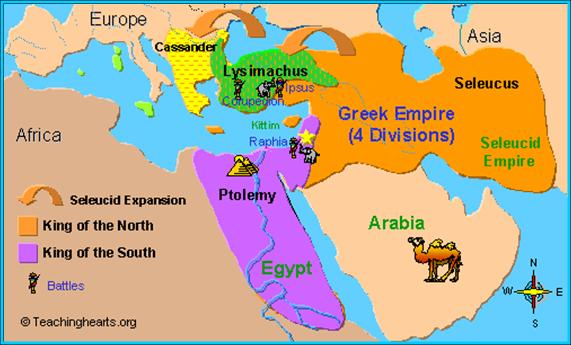
It's good guys versus bad guys with the proviso that while most every Greek ruler is a bad guy, not all the Jews are good guys. Here is a partial list of players. The Jews are: Menelaus (bad), Lysimachus (bad), Jason (bad), Onias (good), Simon (bad), Hyrcanus (not sure), Judas Maccabeus (good), Eleazar (good). The Greeks are: King Seleucus, Heliodorus, Apollonius, Andronicus and Antiochus IV Epiphanes as well as Antiochus V Eupator.
This second reading of 2 Maccabees makes clear that this book recounts three assaults on the temple by the Greek oppressors. Second Maccabees takes a religious perspective, attending more to the temple, its defense, its desecration by foreigners and its subsequent purification (most notably described in Chapter 10 as the eight days of the feast of the booths in the month of Chislev now known as Hanukkah). First Maccabees is considered more of a historical chronicle and perhaps more historically accurate and far less interesting to read.
Second Maccabees gives a vivid picture of the struggle of pious Jews to maintain their religion and culture in the face of all sorts of injustices and temptations visited upon them by their Greek overlords. One such example is the well-known account of the mother and her seven sons who suffer dismemberment and frying for refusing to eat pork.
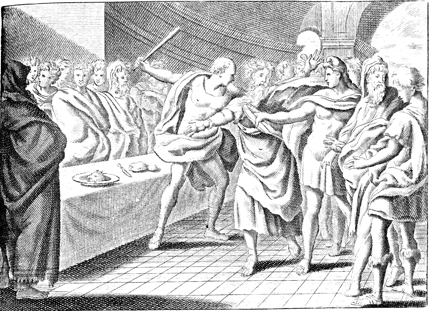
Obtain a piece of the sort of meat you can eat, suggest his wily friends, and consume that meat in front of your persecutors. In such a way, you will save yourself. Eleazar basically says to them, Get behind me, Satan. He refuses to indulge in this deception not only because it is a deception, but because of the harm it will do to the community of believers, especially those who are younger. If such impressionable ones see Eleazar, apparently a man of standing in the community, betray his faith at the ripe old age of 90, what was his faith worth in the first place? Not only will he endure torture for the sake of honoring God, but he will endure it so as not to endanger the beliefs of others who will, by Eleazar's example, see that God's word is true and that it is worth dying for.
The reaction of Eleazar's wily "friends" is a reminder of human pride and the inclination to make ourselves into gods. The friends are angry at Eleazar who has brushed aside their power, their ability to pull strings, their ability to save him. Eleazar lives as we know from the book of Maccabees, at a point in time when there was forming an emergent notion of life after death. At great cost to his physical body, Eleazar demonstrates a secure knowledge that heavenly paradise is the end game, not a few more years on earth because he's entered into a Faustian bargain with some devilish friends. His refusal exposes the friends for what they are---charlatans with swelled heads who think they can offer up a prize that surpasses the one that God offers. It's a powerful reading and humbling.
For a discussion of why 1,2 Maccabees are considered non-canonical by Jews and Protestants see a discussion of requirements for the canon that is forthcoming.
Wednesday, November 13, 2013
Postlogue - Tobit
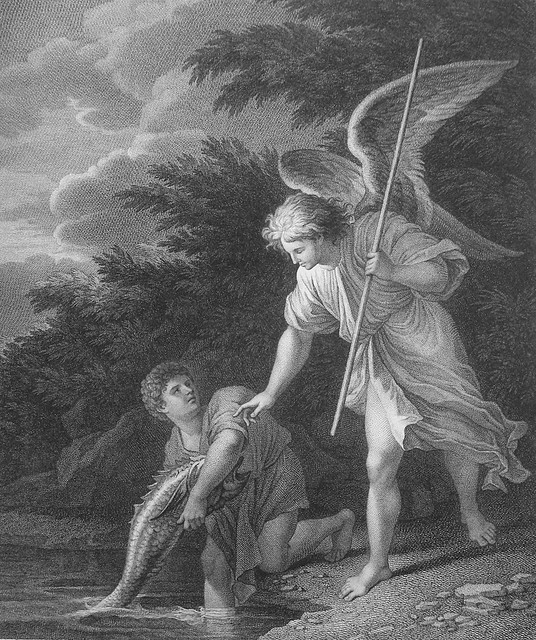 |
| Tobias and Azarias Salvator Rosa Phillip Medhurst Collection |
The painting above by Salvator Rosa is included in the text book for our religious education class of first and second grade girls. The text uses beautiful artwork instead of that cartoonish stuff most dumbed-down curriculums have settled for and this particular picture, which occasioned not a small bit of curiosity on the part of the class, corresponded to a chapter dealing with the body and soul and guardian angels. The lesson could have been conveyed without the picture but there were repeated requests, almost a clamor, for an explanation of the fish, the angel and so I managed to recount the tale. The enchanting story in the Book of Tobit lends itself to telling anyway.
Our catechists, though young, could readily understand that after seven failed marriages, Sarah would be "lonely," "sad, " "disappointed," and "heart-broken." They were indignant at the notion that she might have done away with herself out of despair and were relieved that she decided to put her life in God's hands instead. They appreciated the mystery and intrigue in that the true identity of Tobias's travelling companion was known only to us, the readers. Though initially put off by Raphael's instruction to Tobias to kill the fish ("he must really be a bad angel"), they were back on board by the time Tobias had dispersed the demon Asmodeus, and they cheerfully anticipated Tobias's return to his father because they now knew he would apply the fish gall to Tobit's eyes. All would end happily.
The first and very immediate question at the conclusion of the telling was Did this really happen? Is this story real? Interesting that such questions cross the boundary of age. My sentiments exactly after reading half the books of the Bible! Even at their tender age, the girls wanted to be able to separate fact from fiction. Is this the truth? Can we hang our hat on this? Will God deliver us from demons, despair and blindness? Will God really heal our broken hearts?
The short answer to Did this really happen? is no. The Book of Tobit, which I knew and know to be part of the Apocrypha, is not considered to be historical. This of course is not what the girls were asking and so I didn't give (exactly) this answer. They wanted to know the category in which memory should store this tale for them--really happened and so Tobias was real like George Washington was real or fairy tale fantasy and so Tobias was not real like Prince Charming is not real? If the story isn't "real," then what makes it any different from other fairy tales they know? If guardian angels and prayers to God are just storybook shenanigans, why come to religious education class. Why believe in God at all? (Which, curiously, is how the class began when one among the group reported that her friend had told her today that he didn't believe in God. Perhaps he had gone to the "bad side" was their reasoning.)
The answer as I tried to construct it is that the story is true even if there's no Tobias, no Sarah and no fish. We do have guardian angels, though they may be as unapparent to us as Raphael in his angelic embodiment was unapparent to Tobit and Tobias. If we have faith, if we praise God as did Tobit, Tobias and Sarah, we'll have hope and with hope we'll be able to carry on even in the face of being as our one young catechist said, heart-broken.
I tried to leave the girls with the admonition to pray without ceasing, to always trust in the power of God and their guardian angel to help them. Hopefully, they'll at least never look at a fish the same way again. That cold, scaly creature has a heart, a liver and a gall. It might jump right up and grab you. If it does, and if you get the feeling that you should hang on, well maybe you should. Do as Tobias did and listen for your guardian angel to guide you.
Tuesday, October 29, 2013
End Note
Two years, five months and thirteen days later, I've finished reading the Bible from Genesis to Revelation and everything in between, no skipping around. It's only taken me from May 16, 2011 to October 29, 2013. I have no idea how people read the Bible in one year or ninety days or whatever else they claim to do.
Perhaps some are looking for a more general overview or maybe they have more of a foundation to begin with. In any case, there's no way I could have completed the reading in one year, and, even with my extended-stay style of reading, I'm not sure that I don't have much more than simply a general overview now that I've finished. Alas! Two and a half years of reading! However, it's the Bible, an account of more than 2,000 years of God's interaction with his creation. There's no reason to expect that it should be an easy read.
What can now follow is a different type of reading. I would not opt for going through and re-reading the Bible again as one might do with a long-ago-read favorite novel although over the past two years I have had to do that, particularly with the book of Genesis. I had thought of re-reading the particular books as they correspond to the daily lectionary readings. It would be a perfect time to begin that because Year C is ending and Year A is just about to begin. But that approach may be a bit of hop-scotching that could lead to confusion. Garrison suggests re-reading according to themes of sin, salvation, fear, grace. He suggests using biographies, an idea I like. It seems neat and manageable. Historical time periods is another possibility. There are other guides as well. I attempted to use this one briefly.
Perhaps some are looking for a more general overview or maybe they have more of a foundation to begin with. In any case, there's no way I could have completed the reading in one year, and, even with my extended-stay style of reading, I'm not sure that I don't have much more than simply a general overview now that I've finished. Alas! Two and a half years of reading! However, it's the Bible, an account of more than 2,000 years of God's interaction with his creation. There's no reason to expect that it should be an easy read.
What can now follow is a different type of reading. I would not opt for going through and re-reading the Bible again as one might do with a long-ago-read favorite novel although over the past two years I have had to do that, particularly with the book of Genesis. I had thought of re-reading the particular books as they correspond to the daily lectionary readings. It would be a perfect time to begin that because Year C is ending and Year A is just about to begin. But that approach may be a bit of hop-scotching that could lead to confusion. Garrison suggests re-reading according to themes of sin, salvation, fear, grace. He suggests using biographies, an idea I like. It seems neat and manageable. Historical time periods is another possibility. There are other guides as well. I attempted to use this one briefly.
Revelation
Book Written: Both HC and Baker link the time of writing to periods of religious persecution. One such period is during Nero's reign (54-68 A.D.) 68 A.D. and a later possibility is during Domitian's reign (81-96 A.D.) in 96 A.D.
 Time Period/Setting: The author writes to seven Christian communities in Asia Minor: Pergamum, Thyatira, Smyrna, Sardis, Philadelphia, Ephesus and Laodicea. Yet, these communities would not likely have been being actively persecuted at the time Revelation was written. HC notes that the persecution under Nero affected mostly Christians in Rome. HC says the evidence is scant that Domitian promoted any kind of official persecution of Christians in Asia Minor. Both HC and Baker remind that the book may be a warning of things to come.
HC refers to the author of Revelation as a member of the Johannine community, but certainly not the apostle John. Here, Baker agrees that authorship is uncertain, perhaps attributable to a disciple of John, if not the apostle himself. The author does identify himself as having been on Patmos, Ch. 1, 9.
Title: From the Greek apokalypsis meaning 'revelation,' 'the revealing or disclosure of something hidden' as in Ch 1, 1 "the revelation of Jesus Christ."
I've written a bit here about apocalyptic literature but here are a few helpful reminders concerning such literature since we're on this page. Apocalyptic literature: depicts a conflict between Satan and God or between a present evil time vs. a better time to come; is told in the first person; is abundant in symbolism; may present an "interpreting angel." Regarding symbolism, Baker reminds us that "almost every material thing mentioned stands for something else." Definitely. Babylon is Rome. The 'great whore' is Rome. The beast is the Roman empire. The 'little scroll' is revelation. A lampstand is this, a dragon is that. The number 7 is mentioned 57 times. Baker also admonishes that we not presume the book of Revelation refers to or predicts present-day struggles. The message of the book is specific to its historical time period.

HC refers to the author of Revelation as a member of the Johannine community, but certainly not the apostle John. Here, Baker agrees that authorship is uncertain, perhaps attributable to a disciple of John, if not the apostle himself. The author does identify himself as having been on Patmos, Ch. 1, 9.
Title: From the Greek apokalypsis meaning 'revelation,' 'the revealing or disclosure of something hidden' as in Ch 1, 1 "the revelation of Jesus Christ."
I've written a bit here about apocalyptic literature but here are a few helpful reminders concerning such literature since we're on this page. Apocalyptic literature: depicts a conflict between Satan and God or between a present evil time vs. a better time to come; is told in the first person; is abundant in symbolism; may present an "interpreting angel." Regarding symbolism, Baker reminds us that "almost every material thing mentioned stands for something else." Definitely. Babylon is Rome. The 'great whore' is Rome. The beast is the Roman empire. The 'little scroll' is revelation. A lampstand is this, a dragon is that. The number 7 is mentioned 57 times. Baker also admonishes that we not presume the book of Revelation refers to or predicts present-day struggles. The message of the book is specific to its historical time period.
Thursday, August 15, 2013
Letter of Jude
Book Written: Baker says the date is around 70 A.D. HC only notes that this book could be among the earliest NT writings.
Time Period/Setting: Where Jude writes from or to whom is a bit murky, but HC places Jude in Palestine as a leader of Jewish Christians.
Title: Jude seems to be the agreed-upon author. He is held to be the brother of James, author of the letters and the leader of the church in Jerusalem, and so a cousin of Jesus.
Jude is warning the Christian community (probably Gentile Christians according to Baker, but see above) of the dangers of giving in to "certain intruders" (v.4) who distort the gospel. These "waterless clouds," these "trees without fruit" are "blemishes on your lovefeasts, while they feast with you without fear, feeding themselves" (v. 12). Pretty damning language.
This book includes the beautiful doxology:
Time Period/Setting: Where Jude writes from or to whom is a bit murky, but HC places Jude in Palestine as a leader of Jewish Christians.
Title: Jude seems to be the agreed-upon author. He is held to be the brother of James, author of the letters and the leader of the church in Jerusalem, and so a cousin of Jesus.
Jude is warning the Christian community (probably Gentile Christians according to Baker, but see above) of the dangers of giving in to "certain intruders" (v.4) who distort the gospel. These "waterless clouds," these "trees without fruit" are "blemishes on your lovefeasts, while they feast with you without fear, feeding themselves" (v. 12). Pretty damning language.
This book includes the beautiful doxology:
Now to him who is able to keep you from falling, and to make you stand without blemish in the presence of his glory with rejoicing, to the only God our Savior, through Jesus Christ our Lord, be glory, majesty, power and authority, before all time and now and forever. Amen.
Letter of John, 1, 2 and 3
Book Written: For all three letters, HC places the date at 100 A.D., Baker at 90 A.D.
Time Period/Setting: HC believes these three letters to have been written in Ephesus. For the audience, the "little children," see below. The "elect lady" of 2 John is a particular church, though which one is not known. 3 John is addressed to Gaius whom Baker identifies simply as an important person in the church to which the letter is addressed.
Title: Once again and no surprise, HC calls into question John the apostle and author of the fourth gospel as the writer of these chapters. He identifies the author as perhaps the "elder" in letter 2 or a member of the same early Christian community of the fourth gospel. Baker has no such qualms and identifies the apostle as author of all three letters. Both Baker and HC agree that 1 John is not an actual letter but 2, 3 John are.
Concerning 1 John, HC explains that this speech or sermon may have been written to counter those in the Christian community who were claiming that Jesus was pure spirit and not a physical human being. Baker says the theme in 2 John is remaining faithful to the early teachings of the apostles. The theme of 3 John, a very short letter, discusses administrative matters. All three letters echo the language of the fourth gospel.
Time Period/Setting: HC believes these three letters to have been written in Ephesus. For the audience, the "little children," see below. The "elect lady" of 2 John is a particular church, though which one is not known. 3 John is addressed to Gaius whom Baker identifies simply as an important person in the church to which the letter is addressed.
Title: Once again and no surprise, HC calls into question John the apostle and author of the fourth gospel as the writer of these chapters. He identifies the author as perhaps the "elder" in letter 2 or a member of the same early Christian community of the fourth gospel. Baker has no such qualms and identifies the apostle as author of all three letters. Both Baker and HC agree that 1 John is not an actual letter but 2, 3 John are.
Concerning 1 John, HC explains that this speech or sermon may have been written to counter those in the Christian community who were claiming that Jesus was pure spirit and not a physical human being. Baker says the theme in 2 John is remaining faithful to the early teachings of the apostles. The theme of 3 John, a very short letter, discusses administrative matters. All three letters echo the language of the fourth gospel.
Wednesday, August 14, 2013
Letter of Peter, 2
Book Written: Baker gives the date as around 70 A.D. (though how that could be if Peter is thought to have been killed in 64 A.D. see below). HC puts the date considerably later in the 80s or 90s A.D.
Time Period/Setting: Peter is writing to all Christians of the time, no particular group intended.
Title: Though Baker notes that authorship of this book is controversial, he recognizes its author as Peter. HC does not. He attributes authorship to someone who wrote in Peter's name as, again, HC rather categorically places Peter's martyrdom in the year 64/5 A.D. Baker says this is not actually a letter.
Peter reminds his audience not to revert to pagan ways (HC explains that Christians of this time were caught in a "twin transition from a Jewish to a pagan environment. . .. " He also writes of the Parousia. And the author, whoever he may be, emphasizes the truth of his message because he is one of the "eyewitnesses of his majesty" (Ch.1, 16-18).
Time Period/Setting: Peter is writing to all Christians of the time, no particular group intended.
Title: Though Baker notes that authorship of this book is controversial, he recognizes its author as Peter. HC does not. He attributes authorship to someone who wrote in Peter's name as, again, HC rather categorically places Peter's martyrdom in the year 64/5 A.D. Baker says this is not actually a letter.
Peter reminds his audience not to revert to pagan ways (HC explains that Christians of this time were caught in a "twin transition from a Jewish to a pagan environment. . .. " He also writes of the Parousia. And the author, whoever he may be, emphasizes the truth of his message because he is one of the "eyewitnesses of his majesty" (Ch.1, 16-18).
Letter of Peter, 1
Book Written: Baker simply gives a date of 64 A.D. while HC explains that the letter has to be written after Paul traveled through Asia Minor in the 60s, but before the 90s because there's no mention of Roman officials charging Christians with disobedience to the emperor.
Time Period/Setting: Peter is writing to Christians in five Roman provinces in Asia Minor: Asia, Bithynia, Cappadocia, Galatia and Pontus. HC explains that these Gentile Christians faced considerable animosity towards them on the part of the Greco-Roman society in which they found themselves.
Title: Written by Peter, the apostle and first bishop of Rome though HC calls that into question by saying that the fine quality of the Greek may mean otherwise. HC also says (2 Peter) that Peter was martyred in 64/5 A.D. so HC would conclusively be saying that this letter couldn't have been written by Peter if in fact the letter was penned between 70 A.D. and 90 A.D. The format is considered to be an actual letter.
Peter is urging his readers to be faithful and good servants of Christ and not to revert to their earlier, heathen ways. Just to make things perfectly clear I suppose, Peter enjoins his readers not to consort with those lousy Gentiles whom he denounces as immoral low-lifes in Ch. 4, 3-5. Such riff-raff lives in "licentiousness, passions, drunkenness, revels, carousing and lawless idolatry." Can't get much worse than that!
Time Period/Setting: Peter is writing to Christians in five Roman provinces in Asia Minor: Asia, Bithynia, Cappadocia, Galatia and Pontus. HC explains that these Gentile Christians faced considerable animosity towards them on the part of the Greco-Roman society in which they found themselves.
Title: Written by Peter, the apostle and first bishop of Rome though HC calls that into question by saying that the fine quality of the Greek may mean otherwise. HC also says (2 Peter) that Peter was martyred in 64/5 A.D. so HC would conclusively be saying that this letter couldn't have been written by Peter if in fact the letter was penned between 70 A.D. and 90 A.D. The format is considered to be an actual letter.
Peter is urging his readers to be faithful and good servants of Christ and not to revert to their earlier, heathen ways. Just to make things perfectly clear I suppose, Peter enjoins his readers not to consort with those lousy Gentiles whom he denounces as immoral low-lifes in Ch. 4, 3-5. Such riff-raff lives in "licentiousness, passions, drunkenness, revels, carousing and lawless idolatry." Can't get much worse than that!
Letter of James
Book Written: According to Baker, 57 A.D., according to HC, before 70 A.D.
Time Period/Setting: James is thought to be addressing a live audience if you will, thus this isn't really a letter in the literal sense. His audience is Jewish Christians.
Title: The author is considered to be James, "brother" of Jesus (not James, brother of John and sons of Zebedee, that James having been martyred in 42 A.D.). This James led a Christian church in Jerusalem.
In this book of the Bible James makes the "faith not works" argument which as Baker points out is only an apparent contradiction to Paul's message about faith in Romans Ch. 3, 19 to Ch. 5. As I understand it, Paul was admonishing the new Christians that their righteousness would not result from following every jot and tittle of Jewish law, but rather through their faith in Christ as the risen Messiah. James, it seems, is saying nothing that different. He admonishes his audience not to forget that their faith consists also of demonstrable acts based on love of God and trust in him, much as Abraham was willing to offer up Isaac (Ch.2, 21).
Time Period/Setting: James is thought to be addressing a live audience if you will, thus this isn't really a letter in the literal sense. His audience is Jewish Christians.
Title: The author is considered to be James, "brother" of Jesus (not James, brother of John and sons of Zebedee, that James having been martyred in 42 A.D.). This James led a Christian church in Jerusalem.
In this book of the Bible James makes the "faith not works" argument which as Baker points out is only an apparent contradiction to Paul's message about faith in Romans Ch. 3, 19 to Ch. 5. As I understand it, Paul was admonishing the new Christians that their righteousness would not result from following every jot and tittle of Jewish law, but rather through their faith in Christ as the risen Messiah. James, it seems, is saying nothing that different. He admonishes his audience not to forget that their faith consists also of demonstrable acts based on love of God and trust in him, much as Abraham was willing to offer up Isaac (Ch.2, 21).
Tuesday, August 6, 2013
Letter to the Hebrews
 |
| Abraham and Melchizedek Dieric Bouts |
Book Written: Between 60 A.D. and 95 A.D. according to HC, but Baker gives 70 A.D.
Time Period/Setting: Authorship was for a long time ascribed to Paul, however, that is now an outmoded view. Possible authors are Barnabas, Apollos or Priscilla. HC suggests the intended recipients of the letter may be in Rome.
Title: Called a letter, HC says the Book of Hebrews is really more like a sermon though it does conclude with correspondence-type greetings and farewells to the audience for whom the sermon-letter is intended. HC speculates loosely that the audience is probably Jewish and Christian (does that mean Jewish Christians?).
Baker calls the letter a "treatise on Christology" and HC reminds of the very Greek style of writing (also the language in which it was written?). The discussion of Melchizedek in Chapter 7 and the following discussion of Christ as the high priest are intriguing though mysterious. I happened to read a bit about Melchizedek here.
Years ago I took a class with the Presbyterians on Hebrews. Memory could be playing tricks on me, but what I recall of the class was a series of meditations on various passages of Hebrews with some kind of recorded New Age type music playing at intervals. It was the most unenlightening class on the Bible that I've ever taken, probably due in no small part to the fact that I knew nothing about Christianity or the Bible at the time. It's unfortunate that this association with Hebrews persisted. The class left the impression of Hebrews as being an utterly inscrutable piece of theology to be avoided if possible. Actually, it's a rather beautifully written book with accessible ideas.
Philomen

Book Written: Baker gives a date of 61 A.D. to 63 A.D. while HC rules out a date earlier than 54 A.D. (see below)
Time Period/Setting: The authorship of this letter is attributed to an imprisoned Paul, but which prison and where is not certain. HC questions Rome as a location, preferring Philippi or Caesarea as more likely. For that reason HC fixes an earlier date to the letter. Paul was writing to a wealthy Colossian, Philomen, whose slave, Onesimus, had run away and come to befriend Paul (in Rome according to Baker), undergo a conversion to Christianity and remain as Paul's friend or servant.
Title: see above
Paul is writing to Philomen to say that, though Onesimus is a valued companion and friend, he is sending Onesimus back to Colossae to his master. Paul urges Philomen to treat Onesimus with respect and kindness and perhaps even grant him his freedom.
Letter of Paul to Titus
Book Written: Baker gives a date of 65 A.D. while HC gives 90 A.D. to 110 A.D. as he did for the letters to Timothy
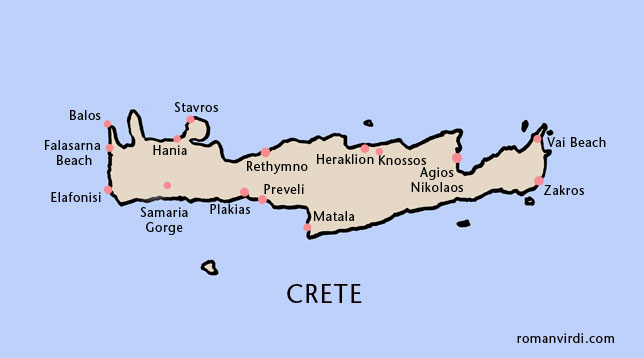
Time Period/Setting: Paul is thought to have written this letter while in Macedonia (per Baker) to his friend Titus who had been left in charge of a church in Crete.
Title: HC casts doubt on Paul as the author.
The content and tone of this letter is very similar to the Timothy letters.
Letter of Paul to Timothy, 2
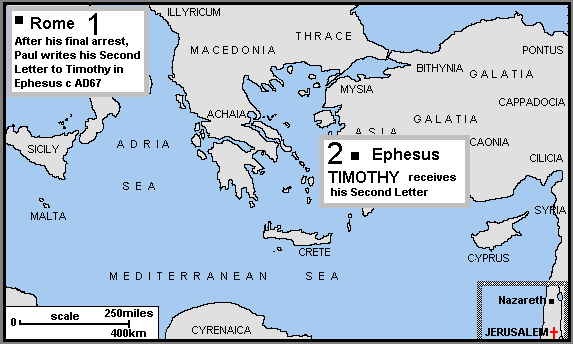
Book Written: Baker gives the date of 66 A.D., but HC holds to the later 90 A.D. to 110 A.D as was the case for 1 Timothy.
Time Period/Setting: This letter is thought to have been written by Paul from a Roman prison. Both Baker and HC describe this letter as a kind of last will and testament from a man about to die.
Title: As with 1 Timothy, HC casts doubt on Paul as the author.
Baker in particular finds these letters to be filled with thoughtful advice delivered in a warm and loving way to a pastor faced with the demands of leading a congregation.
Letter of Paul to Timothy, 1
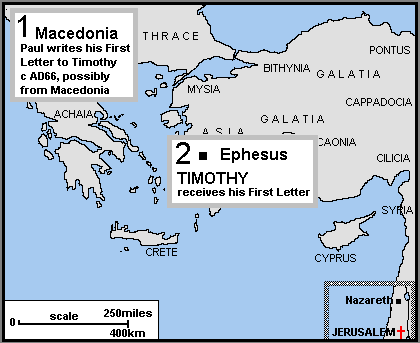
Book Written: 65 A.D. according to Baker but HC puts the date later at 90 A.D. to 110 A.D.
Time Period/Setting: Paul is thought to have written this letter from Macedonia to his friend and colleague, Timothy, who was in Ephesus leading the Christian church there.
Title: HC is considerably more circumspect than Baker about the authorship of this letter as well as 2 Timothy and Titus.
The problem that Timothy faces is primarily false teachings about Christ. Paul gives advice on church leadership and has some more comments about the submission of women, Chapter 2, and the role of young widows, Chapter 5 which are kind of interesting. Baker describes the letter as "a marvelous blend of practical advice from the Apostle of the Gentiles." HC emphasizes more the Hellenistic influences in the writing.
Monday, August 5, 2013
Letter of Paul to the Thessalonians, 2

Book Written: 50 A.D. or 51 A.D.
Time Period/Setting: Paul wrote this book from Corinth to the Gentile converts in Thessalonica, a culturally Greek city in the Roman province of Macedonia.
Title: Self-explanatory
Baker says that in this letter Paul is concerned with explaining that the Parousia (Second Coming) has not occurred and only God knows when it will occur. In Chapter 2, Paul explains that the "lawless one" will be revealed before the parousia, the lawless one being an evil, Satanic force.
The Letter of Paul to the Thessalonians, 1
Book Written: 50A.D. or 51 A.D. The oldest book in the New Testament.
Time Period/Setting: Paul wrote this book from Corinth to the Gentile converts in Thessalonica, a culturally Greek city in the Roman province of Macedonia.
Title: self-explanatory
This letter is geared toward a non-Jewish audience heavily influenced by Greek culture. The Gentile Christians are being persecuted by Jews.
Letter of Paul to the Philippians

Book Written: 54 A.D or the early 60s A.D.
Time Period/Setting: Paul wrote this letter from prison, though exactly which prison and where is unclear. HC says possibilities are Ephesus, Corinth and Caesarea. Baker says Ephesus. Philippi is a port city in Macedonia, a Roman province.
Title: self-explanatory
Paul is very fond of the Philippian community as they are of him. The letter has a warm and joyous tone as Paul writes that no other church has been as kind to Paul as the Philippian church.
Letter of Paul to the Ephesians

Book Written: 61A.D. to 63 A.D. according to Baker, but anywhere from 60s A.D. to 95 A.D. according to HC
Time Period/Setting: Baker says Paul wrote this letter from a Roman prison, but HC says place of authorship is unknown. Paul is writing to Gentile Christians.
Title: Paul is not necessarily the author. According to HC, the author is more likely a student of Paul's who wrote after Paul's death.
This letter may not necessarily have been written to the church in Ephesus, but was rather a more general letter to all churches. Baker says Paul wrote to combat a "challenge to the primacy of Christ in all creation." HC talks about Paul's audience as "experiencing a radical transformation of their personal and social identity."
Chapter 5 contains the familiar verses about the relation of husbands to wives being that of Christ to the Church. Chapter 6 speaks of the relation of children to parents and slaves to masters along with the verses about putting on "the whole armor of God" in order to withstand evil.
Subscribe to:
Posts (Atom)