Book Written: According to Baker, 57 A.D., according to HC, before 70 A.D.
Time Period/Setting: James is thought to be addressing a live audience if you will, thus this isn't really a letter in the literal sense. His audience is Jewish Christians.
Title: The author is considered to be James, "brother" of Jesus (not James, brother of John and sons of Zebedee, that James having been martyred in 42 A.D.). This James led a Christian church in Jerusalem.
In this book of the Bible James makes the "faith not works" argument which as Baker points out is only an apparent contradiction to Paul's message about faith in Romans Ch. 3, 19 to Ch. 5. As I understand it, Paul was admonishing the new Christians that their righteousness would not result from following every jot and tittle of Jewish law, but rather through their faith in Christ as the risen Messiah. James, it seems, is saying nothing that different. He admonishes his audience not to forget that their faith consists also of demonstrable acts based on love of God and trust in him, much as Abraham was willing to offer up Isaac (Ch.2, 21).
Showing posts with label Paul. Show all posts
Showing posts with label Paul. Show all posts
Wednesday, August 14, 2013

Tuesday, August 6, 2013
Letter to the Hebrews
 |
| Abraham and Melchizedek Dieric Bouts |
Book Written: Between 60 A.D. and 95 A.D. according to HC, but Baker gives 70 A.D.
Time Period/Setting: Authorship was for a long time ascribed to Paul, however, that is now an outmoded view. Possible authors are Barnabas, Apollos or Priscilla. HC suggests the intended recipients of the letter may be in Rome.
Title: Called a letter, HC says the Book of Hebrews is really more like a sermon though it does conclude with correspondence-type greetings and farewells to the audience for whom the sermon-letter is intended. HC speculates loosely that the audience is probably Jewish and Christian (does that mean Jewish Christians?).
Baker calls the letter a "treatise on Christology" and HC reminds of the very Greek style of writing (also the language in which it was written?). The discussion of Melchizedek in Chapter 7 and the following discussion of Christ as the high priest are intriguing though mysterious. I happened to read a bit about Melchizedek here.
Years ago I took a class with the Presbyterians on Hebrews. Memory could be playing tricks on me, but what I recall of the class was a series of meditations on various passages of Hebrews with some kind of recorded New Age type music playing at intervals. It was the most unenlightening class on the Bible that I've ever taken, probably due in no small part to the fact that I knew nothing about Christianity or the Bible at the time. It's unfortunate that this association with Hebrews persisted. The class left the impression of Hebrews as being an utterly inscrutable piece of theology to be avoided if possible. Actually, it's a rather beautifully written book with accessible ideas.
Philomen

Book Written: Baker gives a date of 61 A.D. to 63 A.D. while HC rules out a date earlier than 54 A.D. (see below)
Time Period/Setting: The authorship of this letter is attributed to an imprisoned Paul, but which prison and where is not certain. HC questions Rome as a location, preferring Philippi or Caesarea as more likely. For that reason HC fixes an earlier date to the letter. Paul was writing to a wealthy Colossian, Philomen, whose slave, Onesimus, had run away and come to befriend Paul (in Rome according to Baker), undergo a conversion to Christianity and remain as Paul's friend or servant.
Title: see above
Paul is writing to Philomen to say that, though Onesimus is a valued companion and friend, he is sending Onesimus back to Colossae to his master. Paul urges Philomen to treat Onesimus with respect and kindness and perhaps even grant him his freedom.
Letter of Paul to Titus
Book Written: Baker gives a date of 65 A.D. while HC gives 90 A.D. to 110 A.D. as he did for the letters to Timothy
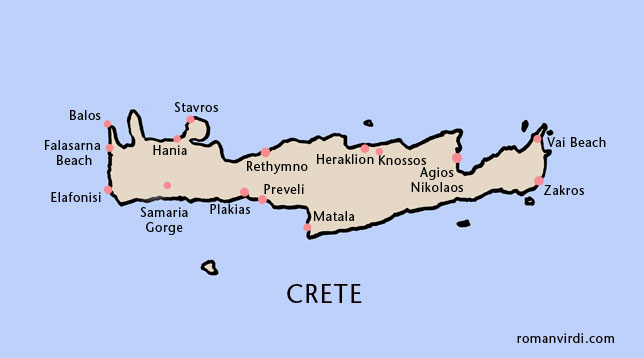
Time Period/Setting: Paul is thought to have written this letter while in Macedonia (per Baker) to his friend Titus who had been left in charge of a church in Crete.
Title: HC casts doubt on Paul as the author.
The content and tone of this letter is very similar to the Timothy letters.
Letter of Paul to Timothy, 2
Book Written: Baker gives the date of 66 A.D., but HC holds to the later 90 A.D. to 110 A.D as was the case for 1 Timothy.
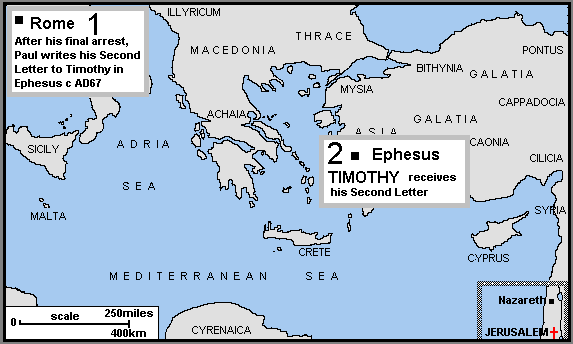
Time Period/Setting: This letter is thought to have been written by Paul from a Roman prison. Both Baker and HC describe this letter as a kind of last will and testament from a man about to die.
Title: As with 1 Timothy, HC casts doubt on Paul as the author.
Baker in particular finds these letters to be filled with thoughtful advice delivered in a warm and loving way to a pastor faced with the demands of leading a congregation.
Letter of Paul to Timothy, 1
Book Written: 65 A.D. according to Baker but HC puts the date later at 90 A.D. to 110 A.D.
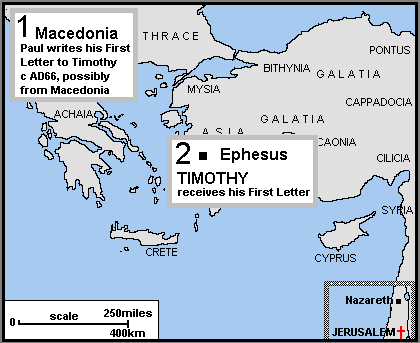
Time Period/Setting: Paul is thought to have written this letter from Macedonia to his friend and colleague, Timothy, who was in Ephesus leading the Christian church there.
Title: HC is considerably more circumspect than Baker about the authorship of this letter as well as 2 Timothy and Titus.
The problem that Timothy faces is primarily false teachings about Christ. Paul gives advice on church leadership and has some more comments about the submission of women, Chapter 2, and the role of young widows, Chapter 5 which are kind of interesting. Baker describes the letter as "a marvelous blend of practical advice from the Apostle of the Gentiles." HC emphasizes more the Hellenistic influences in the writing.
Monday, August 5, 2013
The Letter of Paul to the Thessalonians, 1

Book Written: 50A.D. or 51 A.D. The oldest book in the New Testament.
Time Period/Setting: Paul wrote this book from Corinth to the Gentile converts in Thessalonica, a culturally Greek city in the Roman province of Macedonia.
Title: self-explanatory
This letter is geared toward a non-Jewish audience heavily influenced by Greek culture. The Gentile Christians are being persecuted by Jews.
Letter of Paul to the Philippians

Book Written: 54 A.D or the early 60s A.D.
Time Period/Setting: Paul wrote this letter from prison, though exactly which prison and where is unclear. HC says possibilities are Ephesus, Corinth and Caesarea. Baker says Ephesus. Philippi is a port city in Macedonia, a Roman province.
Title: self-explanatory
Paul is very fond of the Philippian community as they are of him. The letter has a warm and joyous tone as Paul writes that no other church has been as kind to Paul as the Philippian church.
Letter of Paul to the Ephesians

Book Written: 61A.D. to 63 A.D. according to Baker, but anywhere from 60s A.D. to 95 A.D. according to HC
Time Period/Setting: Baker says Paul wrote this letter from a Roman prison, but HC says place of authorship is unknown. Paul is writing to Gentile Christians.
Title: Paul is not necessarily the author. According to HC, the author is more likely a student of Paul's who wrote after Paul's death.
This letter may not necessarily have been written to the church in Ephesus, but was rather a more general letter to all churches. Baker says Paul wrote to combat a "challenge to the primacy of Christ in all creation." HC talks about Paul's audience as "experiencing a radical transformation of their personal and social identity."
Chapter 5 contains the familiar verses about the relation of husbands to wives being that of Christ to the Church. Chapter 6 speaks of the relation of children to parents and slaves to masters along with the verses about putting on "the whole armor of God" in order to withstand evil.
Letter of Paul to the Galatians

Book Written: 54 A.D.
Time Period/Setting: Written by Paul from Ephesus. Galatia was a Roman province near the present-day city of Ankara. Ephesus is at a distance of some 200 miles to the east.
Title: self-explanatory
Paul founded the Galatian Christian churches and is writing to dissuade gullible Galatians from listening to Jewish Christian teachers who are countering Paul's teachings about the new faith, particularly regarding circumcision. HC says these rebellious teachers wanted new converts to Jesus "to undergo circumcision as a sign of their inclusion in God's covenant." Whether they also wanted converts to adhere to Jewish food laws is unclear, but Paul again discusses food in Chapter 2 though his lengthier discussion of food appears in Chapter 8 of 1 Corinthians.
Letter of Paul to the Corinthians, 2

Book Written: Between 54 A.D. and 56 A.D. per HC, but in 57 A.D. per Baker
Time Period/Setting: Written from Macedonia to the same Corinthian community of his first letter. 2 Corinthians is considered to be more disjoint and fragmentary and HC discusses four theories concerning its make-up.
Title: self-explanatory
Just to keep the un-chronology going, HC says that this second letter is actually Paul's fourth letter to his fellow Christians in Corinth.
In this letter, Paul defends himself against a nay-sayer, apparently a particular though un-named individual, who has besmirched Paul's legitimacy as an apostle.
Letter of Paul to the Corinthians, 1
Book Written: 54 A.D.
Time Period/Setting: Written by Paul from Ephesus to the Gentile Christian community in Corinth, a bustling city with a diverse population, in Achaia, a Roman province
Title: self-explanatory
This letter of Paul, called first, is actually Paul's second letter to the Corinthian community per HC. Paul had founded this Christian community and he's writing to them concerning problems that have arisen: leaders proclaiming themselves to have special knowledge, adultery, fornication, prostitution, the persistent problem of clean and unclean food along with the matter of circumcision and resurrection to name a few. Really, Paul covers the spectrum from head coverings to law suits. He was a tireless crusader for the faith certainly and a relentless apologist for it as well, always stressing Christ and his message as the extension of God's covenant with Abraham and the Law.
There are many passages in First Corinthians that read a bit more poetically than those where Paul hammers away at the disobedient Corinthians. Chapter 12 tells of the Church as being many members but one body, and Chapter 13 is the entirely beautiful passage about love (the Greek word used for love here was agape). He writes of the resurrection of body in Chapter 15 as the "perishable body" putting on "imperishability."
Paul does dip in to some dangerous territory by modern-day standards in Chapter 14 much more so than his comments on marriage in Chapter 7. Women, he says, should not speak in church! Oh well, perhaps it would be easier all around if we did keep quiet, along with everyone else who may really have nothing whatsoever to say.
Sunday, August 4, 2013
Letter of Paul to the Romans
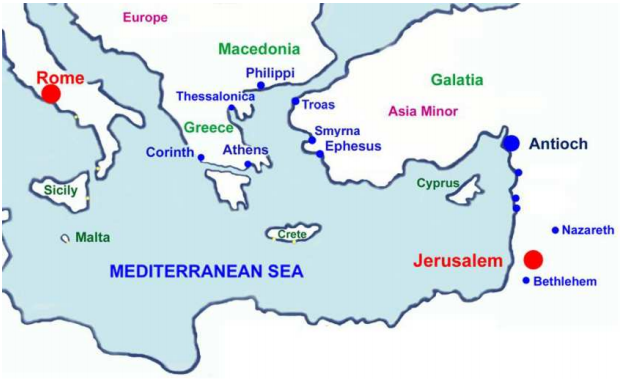
Time Period/Setting: Written by Paul from Corinth to both Jews and returned Jewish Christians in Rome. (In 49 A.D. Claudius expelled Jews and probably Jewish Christians from Rome due to religious unrest most likely the result of Christian influence.) Christian teaching had reached Rome by this time, but apparently not through Paul's efforts.
Title: self-explanatory
Paul's letter to the Romans was among the last of his letters to be written but is first in order of appearance in the Bible. The first shall be last and the last first I suppose; chronological order was apparently not important in compiling the books of the Bible. (I will come to see that the Pauline Letters are arranged in descending order according to the length of each.) The Book of Acts ends with Paul voyaging to Rome, but the Letter to the Romans, the following chapter, was written by Paul without ever having been to Rome.
Baker describes Romans as a "doctrinal treatise" with the theme of justification by faith. HC points out that at the time Paul wrote this letter, he would have had "over two decades" of teaching under his belt. That is evident. To me, the letter is a well-thought-out philosophical piece of writing where Paul uses a sophisticated lawyer-like style of argumentation. He's on fire with the faith. In order to "defend the . . .validity of Israel" to the Roman Christians Paul uses plenty of OT quotations and references to Jewish law. HC says that Paul uses the "diatribe style" to present his position. That is, he writes "as if confronting an individual with a truth that demands a response."
Subscribe to:
Posts (Atom)