I commented on the novel The Red Tent here, but since then I've had the good sense to actually read the whole novel in order to draw conclusions.
If, as my copy of the book states, this novel presents a new view of women in biblical times, I guess I'll assume that it's a new view based on historical evidence of some kind. Or, is it just a new view as in a made-up view loosely based on some historical evidence. I don't know. But having a tendency toward the literal and the practical, I can get myself hung up on questions like 'Could this really have happened?' or 'Was there actually a tent that was red?' Thus, I felt unsettled reading about the wonderfully supportive bonding between all the women in Jacob's tribe. Were women of that time really so dedicated to celebrating their femininity, their fertility, their womanhood and lavishing attentions on one another when they gave birth or started to menstruate? Or, is this 21st century A.D. feminism overlaid on second millenium B.C. women.
I also found the injection of romantic love into the picture a little disconcerting. In the novel, Shechem and Dinah are a case of a head-over-heels-nothing-can-stop-us-now kind of romance. All rose petals and gardenias, dreamy and lush, but why? True, the account of their liaison or marriage in Genesis is ambiguous; Shechem does insist that he wants to marry Dinah which is in part I guess what makes the account of Dinah intriguing for a novelist to speculate upon. But. . . .
There's more 21st century-style romance when Dinah re-marries later on. She finds the perfect guy in Benia the carpenter! Benia has a sense of humor, he's sensitive, he loves Dinah, they have a wonderful sex life and Dinah is completely fulfilled as a woman. And it's 3,000 years ago in the Middle East.
Rebekah is given a role in the novel that she doesn't have in the Bible. The author makes her into a kind of elder stateswoman, a seer and/or healer. Again, I'll assume this is a role that might have accrued to a woman of Rebekah's status. Then again, perhaps there's no historical accuracy here but just the author's fantasy. I don't know. I did poke around and look for interviews with the author and some reviews of the book.
In the final analysis, I guess this type of novel just isn't my cup of tea.
Showing posts with label Women. Show all posts
Showing posts with label Women. Show all posts
Friday, January 4, 2013

Sunday, February 26, 2012
Esther

Years ago in the Presbyterian church, we studied this book and the young, female seminarian teaching the class seemed to be guiding us toward an interpretation of Esther as a feminist (sigh). When I offered during the class that I thought Esther could be described, in a word, as obedient, our seminarian recoiled in mild disgust. Oh well.
Esther is anything but a feminist. She didn't compete with the men around her, she didn't take on masculine ways to achieve her ends and she didn't try to take every man down a peg or two (except for the odious Haman who deserved what he got). She faithfully obeyed her cousin Mordecai and her foreigner husband while simultaneously serving God and her people.
The lack of any mention of God in the Book of Esther never seemed problematic to me, but for comparison, I read the Greek version of Esther which my study Bible includes. That the Greek version reads so smoothly could be taken as an indication that God is without question the force behind all that goes on in the story of Esther. From what mere earthly power could Mordecai and Esther, Jews in a foreign land, have possibly summoned up the courage and resolve to plead for the lives of their people?
Judith
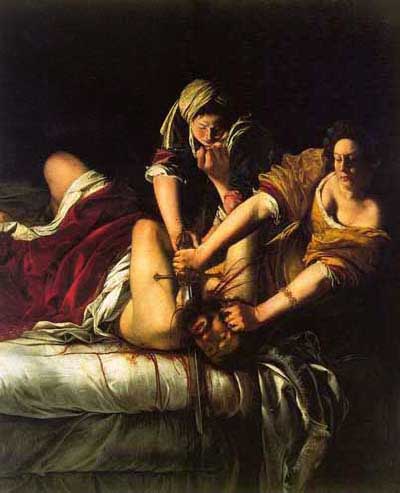
Fortunately, however, I skimmed around and landed on Ch. 8 where the real action begins. Judith is an intriguing personality, an imperious sort, a commanding presence you might say. She's intrepid and plucky, certainly not afraid to get her hands dirty as you can see above. But she does all this without sacrificing her femininity, a good counter-culture role model for the politically feminized woman of today.
Tuesday, December 13, 2011
1 Kings

The book of 1 Kings is a continuation of the Deuteronomistic histories as both the study guides and my study Bible kept reminding me. The two books of Kings are divided up like this: 1) Reign of Solomon from 970 B.C. - 930 B.C. 2) The division of the kingdom after Solomon dies; Israel in the north, Judah in the south and the fall of Israel at the hands of the Assyrians in 722 B.C. 3) The destruction of Jerusalem and the Temple in 587 B.C. at the hands of the Babylonians.
The reign of Solomon includes the building of the temple, Solomon's wisdom in settling the argument between two women who lay claim to the same child, his visit from Queen of Sheba (Sheba thought to be present-day Yemen), not to be confused as I almost did with Solomon's mother Bathsheba. Solomon's marriages, outside the faith as it were, and his willingness to worship the gods--Astarte, Chemosh and Milcom-- of his various wives pretty much spell his downfall and the break-up of the kingdom.
There follows a string of tales about the kings of these respective kingdoms. In Israel there is Jeroboam, Omri and Ahab among others. Ahab is the king who marries the calculating Jezebel. The story of Jezebel's machinations to kill off Naboth in order to deliver to Ahab the coveted vineyard of Naboth is a good one.
A number of prophets appear in this book. There is Ahijah and Elijah the Tishbite. Here is the recounting of the drought and the widow who feeds herself, her son and Elijah for several days even though she had only a small amount of flour and a little oil. In Chapter 22, there is the interesting exchange between the prophets Micaiah, Zedekiah and others un-named. As the note in my study Bible points out, "Even a genuine prophet cannot determine whether another prophet's oracle is true or false." Who knew.
1 Kings ends with the death of Ahab as prophesied by Elijah. Apparently, Jezebel's fate awaits her in 2 Kings.
Monday, December 5, 2011
1st Samuel
Book Written: During the reigns of David and Solomon from 1000 B.C. to 930 B.C.; written by court scribes
Time Period/Setting: The one hundred years from 1070 to 970 B.C. so a transition between the time of Judges and the establishment of the kingdom of Israel; Samuel evenutally becomes one of Israel's judges and will appoint first Saul and then David as kings
Title: Two of my study guides make the point that although this book of the Bible is largely about earthly kings, Saul and David, the book takes the name of the prophet Samuel who appoints them.
In fact, my study Bibles notes that once the Israelites insist on an earthly king, the role of the prophet in the life of Israel changes. "With the advent of kingship, the role of the prophet in the new age is defined as twofold: the prophet will be an intercessor between Israel and the Lord and an advocate of morality and justice." See Chapter 12.
The story begins with another barren wife (Hannah), another rivalry between wives (Hannah vs. Peninnah, wives of Elkanah) and another mother who "sacrifices" her only son (Hannah, Samuel). Hannah explains that for as long Samuel will live, she lends her son to the Lord.
The first book of Samuel gives one of those accounts of God's anger with his disobedient flock that depict the Lord as quick to anger and slow to forgive, just the opposite of how we are to understand him. Much as He says in Genesis that he's sorry that he made us, he tells Samuel, "I regret that I made Saul king, for he has turned back from following me, and has not carried out my commands (15,10-11)." An act of disobedience on the part of Saul prevents him from ruling over Israel forever. He's punished. It's that simple I suppose though it 's a little hard to accept. The matter of obeying God is serious and seems eminently non-negotiable in the Old Testament. When you're bad, you're bad. When you're good, well, at least that's better.
In Chapter 9, Samuel travels to Saul's home country to anoint him as king of Israel. As HC mentions, the account reads like a fairy tale which, ironically, I find, makes the whole account of Samuel seeking out Saul more believable (didn't C.S. Lewis write about that, myths and reality, etc.): Saul goes looking for his father's missing donkeys and finds a kingship besides (the donkeys do turn up). And, looking at the New Testament as an extension of the Old Testament and the Old as a prefiguring of all that is to happen later (allegory or typology according to the Catechism 117.1), Saul, a soon-to-be king of Israel meeting up with a prophet at the well (1 Samuel 9,11-12) is a sign or type of Christ's kingdom and the living water that Christ will bring (John 4, 1-40). Saul joins Isaac and Jacob as such a sign or type. Abraham's servant encounters Isaac's future bride Rebekah at the well (Genesis 24, 15-21) as Isaac will assume the role of patriarch. Jacob meets Rachel at the well (Genesis 29, 9-12) and Jacob will soon be the earthly king of the Hebrew kingdom that will soon follow.
In Chapter 16, we meet up with Ruth and Boaz's grandson, Jesse, father of their great grandson, David. David eventually marries Saul's daughter, Michal, but the intrigue and enmity between Saul and his son-in-law and daughter has none of the devotion and charity that Ruth had toward her in-laws or that Ruth and Boaz demonstrated to one another in their marriage.
Time Period/Setting: The one hundred years from 1070 to 970 B.C. so a transition between the time of Judges and the establishment of the kingdom of Israel; Samuel evenutally becomes one of Israel's judges and will appoint first Saul and then David as kings
Title: Two of my study guides make the point that although this book of the Bible is largely about earthly kings, Saul and David, the book takes the name of the prophet Samuel who appoints them.
In fact, my study Bibles notes that once the Israelites insist on an earthly king, the role of the prophet in the life of Israel changes. "With the advent of kingship, the role of the prophet in the new age is defined as twofold: the prophet will be an intercessor between Israel and the Lord and an advocate of morality and justice." See Chapter 12.
The story begins with another barren wife (Hannah), another rivalry between wives (Hannah vs. Peninnah, wives of Elkanah) and another mother who "sacrifices" her only son (Hannah, Samuel). Hannah explains that for as long Samuel will live, she lends her son to the Lord.
The first book of Samuel gives one of those accounts of God's anger with his disobedient flock that depict the Lord as quick to anger and slow to forgive, just the opposite of how we are to understand him. Much as He says in Genesis that he's sorry that he made us, he tells Samuel, "I regret that I made Saul king, for he has turned back from following me, and has not carried out my commands (15,10-11)." An act of disobedience on the part of Saul prevents him from ruling over Israel forever. He's punished. It's that simple I suppose though it 's a little hard to accept. The matter of obeying God is serious and seems eminently non-negotiable in the Old Testament. When you're bad, you're bad. When you're good, well, at least that's better.
In Chapter 9, Samuel travels to Saul's home country to anoint him as king of Israel. As HC mentions, the account reads like a fairy tale which, ironically, I find, makes the whole account of Samuel seeking out Saul more believable (didn't C.S. Lewis write about that, myths and reality, etc.): Saul goes looking for his father's missing donkeys and finds a kingship besides (the donkeys do turn up). And, looking at the New Testament as an extension of the Old Testament and the Old as a prefiguring of all that is to happen later (allegory or typology according to the Catechism 117.1), Saul, a soon-to-be king of Israel meeting up with a prophet at the well (1 Samuel 9,11-12) is a sign or type of Christ's kingdom and the living water that Christ will bring (John 4, 1-40). Saul joins Isaac and Jacob as such a sign or type. Abraham's servant encounters Isaac's future bride Rebekah at the well (Genesis 24, 15-21) as Isaac will assume the role of patriarch. Jacob meets Rachel at the well (Genesis 29, 9-12) and Jacob will soon be the earthly king of the Hebrew kingdom that will soon follow.
In Chapter 16, we meet up with Ruth and Boaz's grandson, Jesse, father of their great grandson, David. David eventually marries Saul's daughter, Michal, but the intrigue and enmity between Saul and his son-in-law and daughter has none of the devotion and charity that Ruth had toward her in-laws or that Ruth and Boaz demonstrated to one another in their marriage.
Friday, September 30, 2011
Ruth
Book Written: Sometime between 900-700 B.C.
Time Period/Setting: Time of Judges; between 1200-1000 B.C.
Title: Named after protagonist of story though Naomi is equally a central figure
The website, Catholic Womanhood, published my reflection on the Book of Ruth. You can read it here.
Time Period/Setting: Time of Judges; between 1200-1000 B.C.
Title: Named after protagonist of story though Naomi is equally a central figure
The website, Catholic Womanhood, published my reflection on the Book of Ruth. You can read it here.
Friday, June 10, 2011
The Red Tent

I'm also assuming that this is a woman-affirming book, a feminist novel. No harm in that except that it's not of especial interest to me (I have previously dis-avowed any allegiance to feminism!). It is curious, though, that while Dinah's brothers were central to the life of Israel, she, the biological daughter of Jacob and Leah (a real wife, not just one of the maids) is only a footnote. Of course, as in the case of my comment about Cain and Abel, God's ways are not our ways, and if Dinah had been more essential to the life of Israel, we would certainly have heard about her.
In Genesis, Dinah's encounter with Shechem is straightforwardly characterized as rape or "defilement" while in the novel more is made of the love and devotion of Shechem towards Dinah. (I'd have to read the book more carefully to determine if rape is mentioned at all.) This seems an attempt on the author's part to tweak historical reality a bit by making Dinah the object of romantic love whereas women in pre-Christian times were usually characterized as just there for the taking. (Well, Jacob did apparently fall for Rachel so things weren't all bad.) In the novel, Dinah becomes a mid-wife, far more palatable than had the author made her a priestess or warrior. As a midwife, Dinah eventually delivers her own nephew, one of Joseph's sons, a neat sort of Dickensian twist.
Subscribe to:
Posts (Atom)