Showing posts with label Job. Show all posts

Monday, March 18, 2013

Daniel


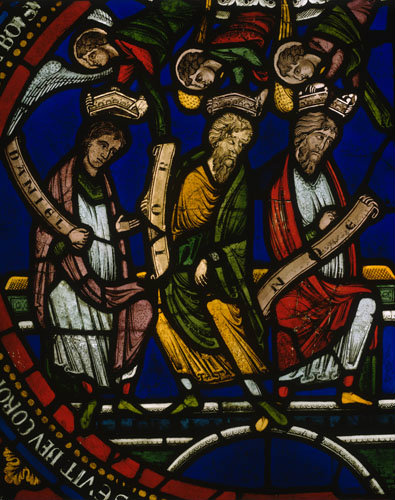
Job, Daniel, Noah Three Righteous Men
 Poor Man's Bible 13th C
Sonia Halliday Photo
Book Written:   165 BC during the reign of Antiochus IV Epiphanes
 
Time Period/Setting:   Babylonian exile, 587-537 BC, Daniel is an exiled Jew living in the court of the Babylonian king

Title:  The use of the name Daniel both for the title of book and its protagonist is probably the same reason the name Solomon was used in the Wisdom of Solomon and the Song of Solomon.  That is to say that a certain Daniel (not even an Israelite?), along with Noah and Job, were "figures known widely in the ancient Near East" and were seen as exceedingly righteous men (Collins). These three are depicted in the stained glass window to the right.  The name Daniel may refer to the Danel or Daniel mentioned in Ezekiel Chapter 14 or it may refer to a judge Danel/Daniel from an Ugarit 14th century BC legend. 

So, first question, was there really a Jewish exile who interpreted Nebuchednezzar's dream and the handwriting on the wall?  And did this exile have friends Hananiah, Mishael and Azariah, renamed in exile respectively as Shadrach, Meshach and Abednego?  Did they endure some sort of torture, whether a fiery furnace or other, and emerge unscathed?  Did Daniel survive a torture, a lion's den or other? 

Regardless of the answers to these (perhaps naive) questions, Baker says that the book of Daniel was written for the purpose of inspiring Jews experiencing the domination if not persecution of a foreign power, the Seleucids.  Daniel is an example of a wise (e.g. his Solomonic role in determining the fate of poor Susanna) and a godly man who shows undying faith in the one God of Israel.  Daniel's God is more powerful than the pagan's idols and Daniel's faith gives him the wisdom to be clearly smarter than the Chaldean sorcerers and priests (e.g. Daniel can interpret the dreams where they are unable). 

As noted earlier, Daniel is deemed the only book in the OT which is truly apocalyptic, though I fail to see why certain chapters of Ezekiel wouldn't qualify.  

Chapter 12 of Daniel alludes to the resurrection of the body and both Baker and Eerdmans say, respectively,  this is the only (?) such reference in the OT and the earliest reference.  However, what about the Wisdom of Solomon, the first five chapters and also the writings in the Books of the Maccabees?

Sunday, February 26, 2012

Job

I began reading the Book of Job under the assumption that  Job was a virtuous soul who refused to blame God for his misfortunes and that he remained steadfastly faithful to the Lord despite the fact that his friends tried to convince him that his loyalty to God was in vain.  Not quite. 

I consulted Garrison who breaks the Book of Job into four-chapter segments and provides explication.  I did a second reading and afterwards felt on firmer ground.  Following is a mix of themes highlighted by Garrison and my own take-aways after the second reading. 

Job, though a believer, has a touch of the rebel in him.  He's a bit of a cynic. A fatalist.  It's all for naught so why bother.   He's good so why has life gone bad?  Though he remains faithful to God, his understanding of the ways of the Lord fall short of the mark.   He seems to feel God has deserted him and perhaps fails to understand that God is not responsible for the misfortune that has befallen him.

A central theme of the book is expressed in Ch.4, 17 and again in Ch. 25.  Can mortals be righteous before God?  Do we achieve righteousness through striving or is it an unearned gift from God?

Why does God bother about us?

The Deuteronomistic notion that evil is punished and virtue is rewarded is too simplistic.  Job is correct in this view unlike his friends who persist in this belief.

If it's impossible for man to be perfect, why bother trying to be good?  We all just end up on the dust heap regardless. What's the meaning of life anyway?  "My days are swifter than a weaver's shuttle, and come to their end without hope." (Ch 7,6)

Job is angry at God (Ch 21-25).

Job says God is persecuting him (Ch 26-28).  Doesn't he know about Satan?

While it is true that Job doesn't denounce God, he really does think that God is responsible for his misery.  He just can't figure out why God has let this happen given that he, Job, is such a great guy (Ch 29-31).

Finally Elihu appears (Ch 32-38) and sheds some light on the controversy between Job and his friends.  Elihu more or less denounces Job as without faith in or understanding of God and accuses Job of blabbering endlessly without making any sense.  Elihu points out (finally someone does) that God can't do wrong.  In Ch 36, 11-13, Elihu seems to be saying that obedience to God is what matters, not whether one is good or evil.   Might he also be saying that Job is too concerned with revenge on evil-doers and their judgment rather than with making sure that he is right before God (Ch 36, 17).

One part that wasn't difficult to understand was the conclusion of the book when God addresses Job.  This language was quite dramatic with vivid and graphic imagery. 

A couple hazy areas remain.  Why does God scold Job and then praise him?  And, how in the world does Elihu come to know all that he knows?