Book Written: Unknown according to HC; about 450 BC according to Baker.
Time Period/Setting: The fall of Jerusalem in 587 BC and after.
Title: The prophet's name which means 'servant of the Lord.'
The single-chapter book begins in the genre of 'oracles against the nations' with an oracle against Edom. The reason Edom would be the subject of an oracle is because the Edomites helped Babylonians in the sacking of Jerusalem.
Tuesday, March 19, 2013

Amos
Book Written: Both Baker and HC say that Amos is the oldest of the books of the prophets though they give no exact dates. Baker adds that Amos is the first prophet to have a book named after him.
Time Period/Setting: The reign of Jeroboam II, 786 BC - 746 BC, the northern kingdom at Bethel. Amos and Hosea are contemporaries.
Author: Amos is a shepherd, not prophet by trade. He hails from the southern kingdom but prophesies in the northern. Along with Isaiah, Hosea and Micah, Amos is one of the four 8th century BC prophets.
Amos is the social justice prophet, speaking as much from his own experience as a laborer as opposed to any formal training in the matter of prophesy. Per Baker, Amos is the first to introduce the "day of the Lord" although the notion more the theme of Joel than Amos
Time Period/Setting: The reign of Jeroboam II, 786 BC - 746 BC, the northern kingdom at Bethel. Amos and Hosea are contemporaries.
Author: Amos is a shepherd, not prophet by trade. He hails from the southern kingdom but prophesies in the northern. Along with Isaiah, Hosea and Micah, Amos is one of the four 8th century BC prophets.
Amos is the social justice prophet, speaking as much from his own experience as a laborer as opposed to any formal training in the matter of prophesy. Per Baker, Amos is the first to introduce the "day of the Lord" although the notion more the theme of Joel than Amos
Joel
 Book Written: Unclear though Baker says around 400 BC.
Time Period/Setting: Unclear though the book refers to an invasion but doesn't mention by what nation
Title: The prophet's name which is a common one and means the same as the name Elijah--'My God is the Lord' - but in reverse order.
The book begins with a colorful description of an enormous invading plague of locusts which I initially took to be a description of an enormous, invading army. Joel introduces the theme of the day of the Lord or the coming of the Lord's Day.
Hosea
Book Written:
Time Period/Setting: The northern Kingdom of Israel, called Ephraim in this book, during the reign of Jeroboam II, 786 BC-746 BC. Hosea was active toward the end of Jeroboam's reign and, according to HC, continued to prophesy until the reign of King Hoshea right before the fall of the northern kingdom to Assyria in 722 BC.
Title: The prophet's name, a shortened form of Hoshaiah meaning 'Yahweh has saved' in Hebrew. Hosea is one of the four 8th century BC prophets along with Isaiah, Amos and Micah.
Hosea marries (is told by the Lord to marry) Gomer who turns out to be an adulteress or a "whoring bride." He rejects her, but then takes her back. Baker sees the marriage motif as key to understanding this book. He explains it this way: .." under the influence of the Holy Spirit, he [Hosea] sees that his experience with Gomer is a symbol or replica of the relationship between Israel (Gomer) and the Lord God (Hosea)." Using marriage to explain Israel's/bride's relation to the Lord/bridegroom is introduced by Hosea and then employed by other prophets (Ezekiel) and also by St. Paul in the NT.
During Hosea's time, Israel has two main sinful flaws. One is turning to foreign powers for help in fending off the ravages of Assyria and the other is worshipping foreign gods, Baal most notably.
Hosea and Amos are contemporaries, both prophets of doom.
Time Period/Setting: The northern Kingdom of Israel, called Ephraim in this book, during the reign of Jeroboam II, 786 BC-746 BC. Hosea was active toward the end of Jeroboam's reign and, according to HC, continued to prophesy until the reign of King Hoshea right before the fall of the northern kingdom to Assyria in 722 BC.
Title: The prophet's name, a shortened form of Hoshaiah meaning 'Yahweh has saved' in Hebrew. Hosea is one of the four 8th century BC prophets along with Isaiah, Amos and Micah.
Hosea marries (is told by the Lord to marry) Gomer who turns out to be an adulteress or a "whoring bride." He rejects her, but then takes her back. Baker sees the marriage motif as key to understanding this book. He explains it this way: .." under the influence of the Holy Spirit, he [Hosea] sees that his experience with Gomer is a symbol or replica of the relationship between Israel (Gomer) and the Lord God (Hosea)." Using marriage to explain Israel's/bride's relation to the Lord/bridegroom is introduced by Hosea and then employed by other prophets (Ezekiel) and also by St. Paul in the NT.
During Hosea's time, Israel has two main sinful flaws. One is turning to foreign powers for help in fending off the ravages of Assyria and the other is worshipping foreign gods, Baal most notably.
Hosea and Amos are contemporaries, both prophets of doom.
Monday, March 18, 2013
Daniel

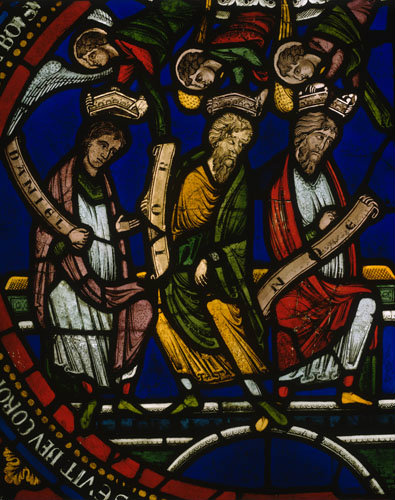 |
| Job, Daniel, Noah Three Righteous Men Poor Man's Bible 13th C Sonia Halliday Photo |
Title: The use of the name Daniel both for the title of book and its protagonist is probably the same reason the name Solomon was used in the Wisdom of Solomon and the Song of Solomon. That is to say that a certain Daniel (not even an Israelite?), along with Noah and Job, were "figures known widely in the ancient Near East" and were seen as exceedingly righteous men (Collins). These three are depicted in the stained glass window to the right. The name Daniel may refer to the Danel or Daniel mentioned in Ezekiel Chapter 14 or it may refer to a judge Danel/Daniel from an Ugarit 14th century BC legend.
So, first question, was there really a Jewish exile who interpreted Nebuchednezzar's dream and the handwriting on the wall? And did this exile have friends Hananiah, Mishael and Azariah, renamed in exile respectively as Shadrach, Meshach and Abednego? Did they endure some sort of torture, whether a fiery furnace or other, and emerge unscathed? Did Daniel survive a torture, a lion's den or other?
Regardless of the answers to these (perhaps naive) questions, Baker says that the book of Daniel was written for the purpose of inspiring Jews experiencing the domination if not persecution of a foreign power, the Seleucids. Daniel is an example of a wise (e.g. his Solomonic role in determining the fate of poor Susanna) and a godly man who shows undying faith in the one God of Israel. Daniel's God is more powerful than the pagan's idols and Daniel's faith gives him the wisdom to be clearly smarter than the Chaldean sorcerers and priests (e.g. Daniel can interpret the dreams where they are unable).
As noted earlier, Daniel is deemed the only book in the OT which is truly apocalyptic, though I fail to see why certain chapters of Ezekiel wouldn't qualify.
Chapter 12 of Daniel alludes to the resurrection of the body and both Baker and Eerdmans say, respectively, this is the only (?) such reference in the OT and the earliest reference. However, what about the Wisdom of Solomon, the first five chapters and also the writings in the Books of the Maccabees?
Ezekiel
Book Written: About 550 B.C. (by Ezekiel's disciples?).
Time Period/Setting: The Babylonian exile, specifically the years 593-571 B.C. when Ezekiel was prophesying. Ezekiel prophesies from Babylon to the exiled community there with him as well as to Jerusalem.
Title: The prophet's name.
Ezekiel is prophet, priest and contemporary of Jeremiah. Garrison cautions against applying Ezekiel's prophesies to current events as a modern-day "fire-breathing evangelist" might do. Could he mean someone like this? Garrison says such interpretations miss the point of the book by focusing on doomsday predictions about modern times, rather than Ezekiel's universal message about God's unmatchable power, personal conversion and the suffering caused by sin. See below on apocalyptic literature.
Garrison advises skimming this book, but it was near impossible to skim the first three chapters describing Ezekiel's call to prophesy and his vision of the four-faced, winged and wheeled creatures. Fantastical and bizarre images! The song hardly does the Biblical text justice.
Equally unskimmable was Chapter 16 where Israel is depicted with unrelenting insistence as the "whoring" bride of the Lord. It was also hard to skim Chapter 37, 'dem dry bones. Do you not remember the song? The image of Ezekiel prophesying to some bones in a Mesopotamian valley as the bones rattle, join together, take on sinew, flesh, skin and finally life when Ezekiel breathes on 'dem--the toe bone connected to the foot bone, the foot bone connected to the---well, take a look and listen here . Who wouldn't squirm and sweat? It is, in a word, unbelievable. Isn't it a prefiguring, albeit a crude one, of the resurrection that will follow once the Messiah has come into the world? Collins doesn't make much of it in his notes.
The excruciating details concerning Ezekiel's vision of the new temple in Chapter 40 compel one to read every word rather than skim. Just the circumstances of the vision preclude skimming the final chapters 40 to 48. Ezekiel is carried to a high mountain by the Lord and is then ushered through the new temple by a man whose "appearance shone like bronze." And, the man measures every nook and cranny with his measuring reed as he takes Ezekiel around! Why, I don't know. These few examples, plus simply the length of the book make Ezekiel a text to be reckoned with.
Lastly there's the matter of apocalyptic literature, a genre of writing particular to Judaism between 250 BC and 250 AD, but having its roots in Near East mythology. Baker says that its origins are to be found in Ezekiel, but there is also evidence of it in the OT books of Haggai, Zechariah, Joel and Malachi. Eerdmans says the only "true" example of apocalyptic writing is in the book of Daniel, Ch 7-12. The word itself is from the Greek and means revelation or disclosure. Eerdmans:
Time Period/Setting: The Babylonian exile, specifically the years 593-571 B.C. when Ezekiel was prophesying. Ezekiel prophesies from Babylon to the exiled community there with him as well as to Jerusalem.
Title: The prophet's name.
Ezekiel is prophet, priest and contemporary of Jeremiah. Garrison cautions against applying Ezekiel's prophesies to current events as a modern-day "fire-breathing evangelist" might do. Could he mean someone like this? Garrison says such interpretations miss the point of the book by focusing on doomsday predictions about modern times, rather than Ezekiel's universal message about God's unmatchable power, personal conversion and the suffering caused by sin. See below on apocalyptic literature.
Garrison advises skimming this book, but it was near impossible to skim the first three chapters describing Ezekiel's call to prophesy and his vision of the four-faced, winged and wheeled creatures. Fantastical and bizarre images! The song hardly does the Biblical text justice.
Equally unskimmable was Chapter 16 where Israel is depicted with unrelenting insistence as the "whoring" bride of the Lord. It was also hard to skim Chapter 37, 'dem dry bones. Do you not remember the song? The image of Ezekiel prophesying to some bones in a Mesopotamian valley as the bones rattle, join together, take on sinew, flesh, skin and finally life when Ezekiel breathes on 'dem--the toe bone connected to the foot bone, the foot bone connected to the---well, take a look and listen here . Who wouldn't squirm and sweat? It is, in a word, unbelievable. Isn't it a prefiguring, albeit a crude one, of the resurrection that will follow once the Messiah has come into the world? Collins doesn't make much of it in his notes.
The excruciating details concerning Ezekiel's vision of the new temple in Chapter 40 compel one to read every word rather than skim. Just the circumstances of the vision preclude skimming the final chapters 40 to 48. Ezekiel is carried to a high mountain by the Lord and is then ushered through the new temple by a man whose "appearance shone like bronze." And, the man measures every nook and cranny with his measuring reed as he takes Ezekiel around! Why, I don't know. These few examples, plus simply the length of the book make Ezekiel a text to be reckoned with.
Lastly there's the matter of apocalyptic literature, a genre of writing particular to Judaism between 250 BC and 250 AD, but having its roots in Near East mythology. Baker says that its origins are to be found in Ezekiel, but there is also evidence of it in the OT books of Haggai, Zechariah, Joel and Malachi. Eerdmans says the only "true" example of apocalyptic writing is in the book of Daniel, Ch 7-12. The word itself is from the Greek and means revelation or disclosure. Eerdmans:
"Apocalypses are characterized by the presence of vision, symbolism, a human seer and an other-worldly mediator, an otherworldly journey, an emphasis on events in the cosmic rather than human realm, an increased interest in angels and demons, the notion of transcendence of God, and pseudonymity." p. 72Eerdmans gives three characteristics of the apocalyptic genre:
1) it is a first person narrative. .. "with revelatory visions often mediated to the author by a supernatural being" 2) the content communicated is eschatological in nature and achieved through a variety of devices, both literary and visual such that 3) those hearing the message will behave in "conformity with the transcendent perspectives." p. 1124-1125There is much more of course, but time to move on to the Book of Daniel.
Friday, February 15, 2013
Baruch
Book Written: Most likely sometime after 180 B.C. or anywhere from 200 to 60 B.C. Baker says the book is "attributed" to Baruch (who of course wasn't living in 180 B.C.), but is the work of 3-4 different authors.
Time Period/Setting: Baruch writes from Babylon both to those left behind in Jerusalem after the second deporation, so after 587 B.C., as well as to those in exile. However, Baruch was thought to have remained behind in Judah with Jeremiah and both are thought to have gone to Egypt.
Title: Baruch is the name of Jeremiah's secretary and friend. The Hebrew meaning is 'he who is blessed.'
The five chapters of Baruch follow Lamentations in the Catholic Bible and include the Letter of Jeremiah as its sixth chapter. Baruch contains a wisdom poem which equates wisdom with the Torah. The Letter of Jeremiah dates to somewhere between the fourth to second century B.C. Its author uses the name of Jeremiah to give credence to the writing and because the letter "developed the venerable prophet's ideas. . ." (HC) The Letter is an exegesis on the evils of idols.
Time Period/Setting: Baruch writes from Babylon both to those left behind in Jerusalem after the second deporation, so after 587 B.C., as well as to those in exile. However, Baruch was thought to have remained behind in Judah with Jeremiah and both are thought to have gone to Egypt.
Title: Baruch is the name of Jeremiah's secretary and friend. The Hebrew meaning is 'he who is blessed.'
The five chapters of Baruch follow Lamentations in the Catholic Bible and include the Letter of Jeremiah as its sixth chapter. Baruch contains a wisdom poem which equates wisdom with the Torah. The Letter of Jeremiah dates to somewhere between the fourth to second century B.C. Its author uses the name of Jeremiah to give credence to the writing and because the letter "developed the venerable prophet's ideas. . ." (HC) The Letter is an exegesis on the evils of idols.
Subscribe to:
Posts (Atom)